

Get New 2025 Valid Practice Microsoft Azure DP-100 Q&A - Testing Engine
DP-100 Dumps PDF - 100% Passing Guarantee
Microsoft DP-100 certification exam is a valuable credential for data scientists and machine learning engineers who want to demonstrate their proficiency in designing and implementing data science solutions on Azure. DP-100 exam covers a wide range of topics related to data science and machine learning and requires candidates to have a deep understanding of Azure data services. To prepare for the exam, candidates can take advantage of various resources provided by Microsoft, including online training courses, study guides, and practice exams.
NEW QUESTION # 186
You manage an Azure Machine Learning workspace named workspace1by using the Python SDK v2.
You must register datastores in workspace 1 for Azure Blot storage and Azure Fetes storage to meet the following requirements.
* Azure Active Directory (Azure AD) authentication must be used for access to storage when possible.
* Credentials and secrets steed in workspace1 must be valid lot a specified time period when accessing Azure Files storage.
You need to configure a security access method used to register the Azure Blob and azure files storage in workspace1.
Which security access method should you configure? To answer, select the appropriate options in the answer area.
NOTE: Each correct selection is worth one point.
Answer:
Explanation:
Explanation:
NEW QUESTION # 187
You use Azure Machine Learning to implement hyperparameter tuning for an Azure ML Python SDK v2-based model training.
Training runs must terminate when the primary metric is lowered by 25 percent or more compared to the best performing run.
You need to configure an early termination policy to terminate training jobs.
Which values should you use? To answer, select the appropriate options in the answer area.
NOTE: Each correct selection is worth one point.
Answer:
Explanation:
Explanation
NEW QUESTION # 188
You are using C-Support Vector classification to do a multi-class classification with an unbalanced training dataset. The C-Support Vector classification using Python code shown below:
You need to evaluate the C-Support Vector classification code.
Which evaluation statement should you use? To answer, select the appropriate options in the answer area.
NOTE: Each correct selection is worth one point.
Answer:
Explanation:
Explanation
Box 1: Automatically adjust weights inversely proportional to class frequencies in the input data The "balanced" mode uses the values of y to automatically adjust weights inversely proportional to class frequencies in the input data as n_samples / (n_classes * np.bincount(y)).
Box 2: Penalty parameter
Parameter: C : float, optional (default=1.0)
Penalty parameter C of the error term.
References:
https://scikit-learn.org/stable/modules/generated/sklearn.svm.SVC.html
NEW QUESTION # 189
You have a dataset that includes home sales data for a city. The dataset includes the following columns.
Each row in the dataset corresponds to an individual home sales transaction.
You need to use automated machine learning to generate the best model for predicting the sales price based on the features of the house.
Which values should you use? To answer, select the appropriate options in the answer area.
NOTE: Each correct selection is worth one point.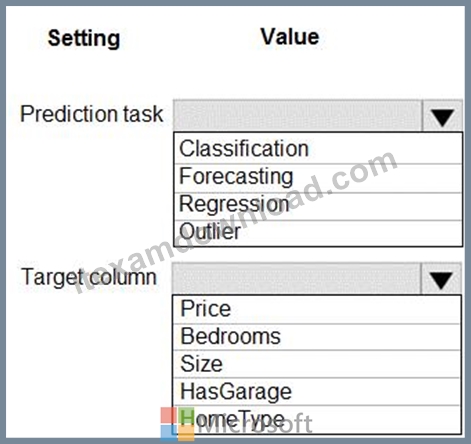
Answer:
Explanation:
Explanation:
Box 1: Regression
Regression is a supervised machine learning technique used to predict numeric values.
Box 2: Price
Reference:
https://docs.microsoft.com/en-us/learn/modules/create-regression-model-azure-machine-learning-designer
NEW QUESTION # 190
Note: This question is part of a series of questions that present the same scenario. Each question in the series contains a unique solution that might meet the stated goals. Some question sets might have more than one correct solution, while others might not have a correct solution.
After you answer a question in this section, you will NOT be able to return to it. As a result, these questions will not appear in the review screen.
You have an Azure Machine Learning workspace. You connect to a terminal session from the Notebooks page in Azure Machine Learning studio.
You plan to add a new Jupyter kernel that will be accessible from the same terminal session.
You need to perform the task that must be completed before you can add the new kernel.
Solution: Delete the Python 3.6 - AzureML kernel.
Does the solution meet the goal?
- A. No
- B. Yes
Answer: A
NEW QUESTION # 191
You create an Azure Machine Learning workspace.
You must use the Python SDK v2 to implement an experiment from a Jupyter notebook in the workspace. The experiment must log string metrics. You need to implement the method to log the string metrics. Which method should you use?
- A. mlflow.log_artifact()
- B. mlflow.log.dict()
- C. mlflowlog_metrk()
- D. mlflow.log text()
Answer: D
NEW QUESTION # 192
You have a dataset that contains 2,000 rows. You are building a machine learning classification model by using Azure Learning Studio. You add a Partition and Sample module to the experiment.
You need to configure the module. You must meet the following requirements:
Divide the data into subsets
Assign the rows into folds using a round-robin method
Allow rows in the dataset to be reused
How should you configure the module? To answer, select the appropriate options in the dialog box in the answer area.
NOTE: Each correct selection is worth one point.
Answer:
Explanation:
Explanation:
Use the Split data into partitions option when you want to divide the dataset into subsets of the data. This option is also useful when you want to create a custom number of folds for cross-validation, or to split rows into several groups.
Add the Partition and Sample module to your experiment in Studio (classic), and connect the dataset.
For Partition or sample mode, select Assign to Folds.
Use replacement in the partitioning: Select this option if you want the sampled row to be put back into the pool of rows for potential reuse. As a result, the same row might be assigned to several folds.
If you do not use replacement (the default option), the sampled row is not put back into the pool of rows for potential reuse. As a result, each row can be assigned to only one fold.
Randomized split: Select this option if you want rows to be randomly assigned to folds.
If you do not select this option, rows are assigned to folds using the round-robin method.
References:
https://docs.microsoft.com/en-us/azure/machine-learning/studio-module-reference/partition-and-sample
NEW QUESTION # 193
You have an Azure Machine Learning workspace that includes an AmICompute cluster and a batch endpoint. You clone a repository that contains an MLflow model to your local computer. You need to ensure that you can deploy the model to the batch endpoint.
Solution: Create a data asset in the workspace.
Does the solution meet the goal?
- A. No
- B. Yes
Answer: A
NEW QUESTION # 194
Hotspot Question
You collect data from a nearby weather station.
You have a pandas dataframe named weather_df that includes the following data:
The data is collected every 12 hours: noon and midnight.
You plan to use automated machine learning to create a time-series model that predicts temperature over the next seven days. For the initial round of training, you want to train a maximum of 50 different models.
You must use the Azure Machine Learning SDK to run an automated machine learning experiment to train these models.
You need to configure the automated machine learning run.
How should you complete the AutoMLConfig definition? To answer, select the appropriate options in the answer area.
NOTE: Each correct selection is worth one point.
Answer:
Explanation:
Explanation:
Box 1: forcasting
Task: The type of task to run. Values can be 'classification', 'regression', or 'forecasting' depending on the type of automated ML problem to solve.
Box 2: temperature
The training data to be used within the experiment. It should contain both training features and a label column (optionally a sample weights column).
Box 3: observation_time
time_column_name: The name of the time column. This parameter is required when forecasting to specify the datetime column in the input data used for building the time series and inferring its frequency. This setting is being deprecated. Please use forecasting_parameters instead.
Box 4: 7
"predicts temperature over the next seven days"
max_horizon: The desired maximum forecast horizon in units of time-series frequency. The default value is 1.
Units are based on the time interval of your training data, e.g., monthly, weekly that the forecaster should predict out. When task type is forecasting, this parameter is required.
Box 5: 50
"For the initial round of training, you want to train a maximum of 50 different models." Iterations: The total number of different algorithm and parameter combinations to test during an automated ML experiment.
Reference:
https://docs.microsoft.com/en-us/python/api/azureml-train-automl-client/ azureml.train.automl.automlconfig.automlconfig
NEW QUESTION # 195
Note: This question is part of a series of questions that present the same scenario. Each question in the series contains a unique solution that might meet the stated goals. Some question sets might have more than one correct solution, while others might not have a correct solution.
After you answer a question in this section, you will NOT be able to return to it. As a result, these questions will not appear in the review screen.
You create an Azure Machine Learning service datastore in a workspace. The datastore contains the following files:
* /data/2018/Q1.csv
* /data/2018/Q2.csv
* /data/2018/Q3.csv
* /data/2018/Q4.csv
* /data/2019/Q1.csv
All files store data in the following format:
id,f1,f2i
1,1.2,0
2,1,1,
1 3,2.1,0
You run the following code:
You need to create a dataset named training_data and load the data from all files into a single data frame by using the following code:
Solution: Run the following code:
Does the solution meet the goal?
- A. No
- B. Yes
Answer: A
Explanation:
Use two file paths.
Use Dataset.Tabular_from_delimeted, instead of Dataset.File.from_files as the data isn't cleansed.
Reference:
https://docs.microsoft.com/en-us/azure/machine-learning/how-to-create-register-datasets
NEW QUESTION # 196
You are training machine learning models in Azure Machine Learning. You use Hyperdrive to tune the hyperparameter.
In previous model training and tuning runs, many models showed similar performance.
You need to select an early termination policy that meets the following requirements:
* accounts for the performance of all previous runs when evaluating the current run
* avoids comparing the current run with only the best performing run to date Which two early termination policies should you use? Each correct answer presents part of the solution.
NOTE: Each correct selection is worth one point.
- A. Bandit
- B. Truncation selection
- C. Default
- D. Median stopping
Answer: C,D
Explanation:
The Median Stopping policy computes running averages across all runs and cancels runs whose best performance is worse than the median of the running averages.
If no policy is specified, the hyperparameter tuning service will let all training runs execute to completion.
Incorrect Answers:
B: BanditPolicy defines an early termination policy based on slack criteria, and a frequency and delay interval for evaluation.
The Bandit policy takes the following configuration parameters:
slack_factor: The amount of slack allowed with respect to the best performing training run. This factor specifies the slack as a ratio.
D: The Truncation selection policy periodically cancels the given percentage of runs that rank the lowest for their performance on the primary metric. The policy strives for fairness in ranking the runs by accounting for improving model performance with training time. When ranking a relatively young run, the policy uses the corresponding (and earlier) performance of older runs for comparison. Therefore, runs aren't terminated for having a lower performance because they have run for less time than other runs.
Reference:
https://docs.microsoft.com/en-us/python/api/azureml-train-core/azureml.train.hyperdrive.medianstoppingpolicy
https://docs.microsoft.com/en-us/python/api/azureml-train-core/
azureml.train.hyperdrive.truncationselectionpolicy
https://docs.microsoft.com/en-us/python/api/azureml-train-core/azureml.train.hyperdrive.banditpolicy
NEW QUESTION # 197
You plan to use Hyperdrive to optimize the hyperparameters selected when training a model. You create the following code to define options for the hyperparameter experiment

For each of the following statements, select Yes if the statement is true. Otherwise, select No. NOTE: Each correct selection is worth one point.
Answer:
Explanation:
Reference:
https://docs.microsoft.com/en-us/python/api/azureml-train-core/azureml.train.hyperdrive.hyperdriveconfig
https://docs.microsoft.com/en-us/azure/machine-learning/how-to-tune-hyperparameters
NEW QUESTION # 198
You need to resolve the local machine learning pipeline performance issue. What should you do?
- A. Increase the training iterations,
- B. Increase the learning rate.
- C. Increase Central Processing Units (CPUs).
- D. Increase Graphic Processing Units (GPUs).
Answer: D
NEW QUESTION # 199
You create a multi-class image classification deep learning model.
The model must be retrained monthly with the new image data fetched from a public web portal. You create an Azure Machine Learning pipeline to fetch new data, standardize the size of images and retrain the model.
You need to use the Azure Machine Learning Python SEX v2 to configure the schedule for the pipeline. The schedule should be defined by using the frequency and interval properties with frequency set to month' and interval set to "1:
Which three classes should you instantiate in sequence"' To answer, move the appropriate actions from the list of actions to the answer area and arrange them in the correct order.
Answer:
Explanation:
Explanation:
NEW QUESTION # 200
You create an Azure Machine Learning workspace and set up a development environment. You plan to train a deep neural network (DNN) by using the Tensorflow framework and by using estimators to submit training scripts.
You must optimize computation speed for training runs.
You need to choose the appropriate estimator to use as well as the appropriate training compute target configuration.
Which values should you use? To answer, select the appropriate options in the answer area.
NOTE: Each correct selection is worth one point.
Answer:
Explanation:
Explanation:
Box 1: Tensorflow
TensorFlow represents an estimator for training in TensorFlow experiments.
Box 2: 12 vCPU, 112 GB memory..,2 GPU,..
Use GPUs for the deep neural network.
Reference:
https://docs.microsoft.com/en-us/python/api/azureml-train-core/azureml.train.dnn
NEW QUESTION # 201
You are developing a machine learning, experiment by using Azure. The following images show the input and output of a machine learning experiment:
Use the drop-down menus to select the answer choice that answers each question based on the information presented in the graphic.
NOTE: Each correct selection is worth one point.
Answer:
Explanation:
NEW QUESTION # 202
Hotspot Question
Complete the sentence by selecting the correct option in the answer area.
Answer:
Explanation:
Explanation:
Use the Convert to ARFF module in Azure Machine Learning Studio, to convert datasets and results in Azure Machine Learning to the attribute-relation file format used by the Weka toolset.
This format is known as ARFF.
The ARFF data specification for Weka supports multiple machine learning tasks, including data preprocessing, classification, and feature selection. In this format, data is organized by entities and their attributes, and is contained in a single text file.
Reference: https://docs.microsoft.com/en-us/azure/machine-learning/studio-module- reference/convert-to-arff
NEW QUESTION # 203
......
Microsoft DP-100 certification exam is designed to test your knowledge of designing and implementing data science solutions on Microsoft Azure. DP-100 exam is intended for data scientists, data analysts, and other professionals who work with data on the Azure platform. By earning this certification, you can demonstrate your expertise in using Azure technologies to create effective data science solutions.
DP-100 Braindumps Real Exam Updated on Sep 23, 2025 with 508 Questions: https://testking.itexamdownload.com/DP-100-valid-questions.html